
December 2025 proved to be a consolidation-heavy, range-bound month for Indian equities, marking a pause after the strong rally of the preceding quarter, with the Sensex and Nifty hovering close to record highs rather than extending gains. Both indices spent most of the month oscillating within narrow bands—Sensex broadly between 84,000 and 86,000 and Nifty around 25,700–26,300—reflecting a market that was digesting earlier gains amid mixed global and domestic cues. Early-month highs gave way to profit-booking, but every meaningful dip was met with buying support, allowing the indices to end the month near mid-December levels, with Sensex closing close to 85,220 after a sharp year-end bounce and Nifty finishing around the 25,939–26,130 zone. Weekly patterns through December reflected this balance, with modest declines such as a − 0.52% Sensex move in the week ending December 12 and −0.31% for Nifty in the week ending December 19, followed by late-month stabilization and mild gains, including a 0.74% rise for Nifty on December 31.
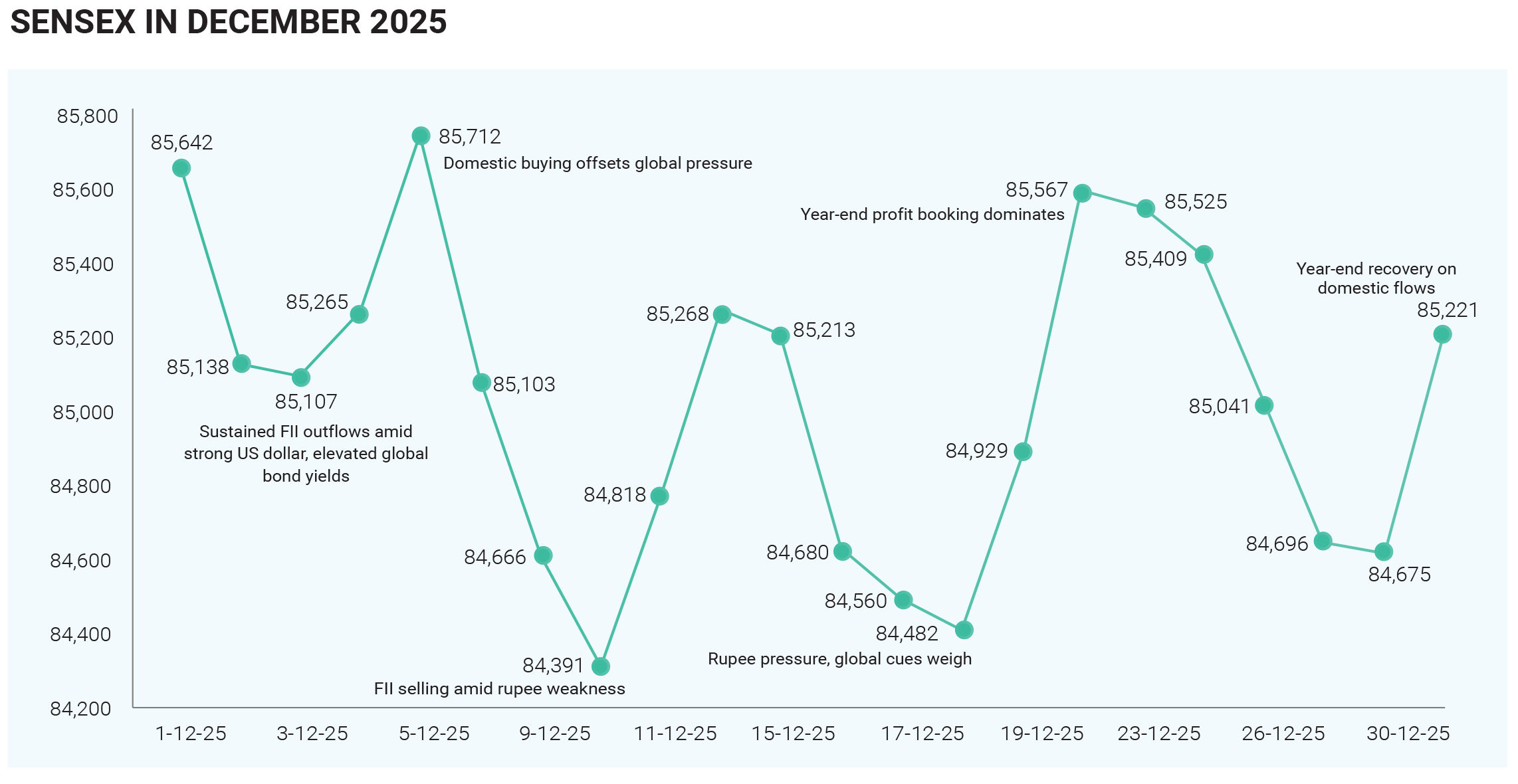
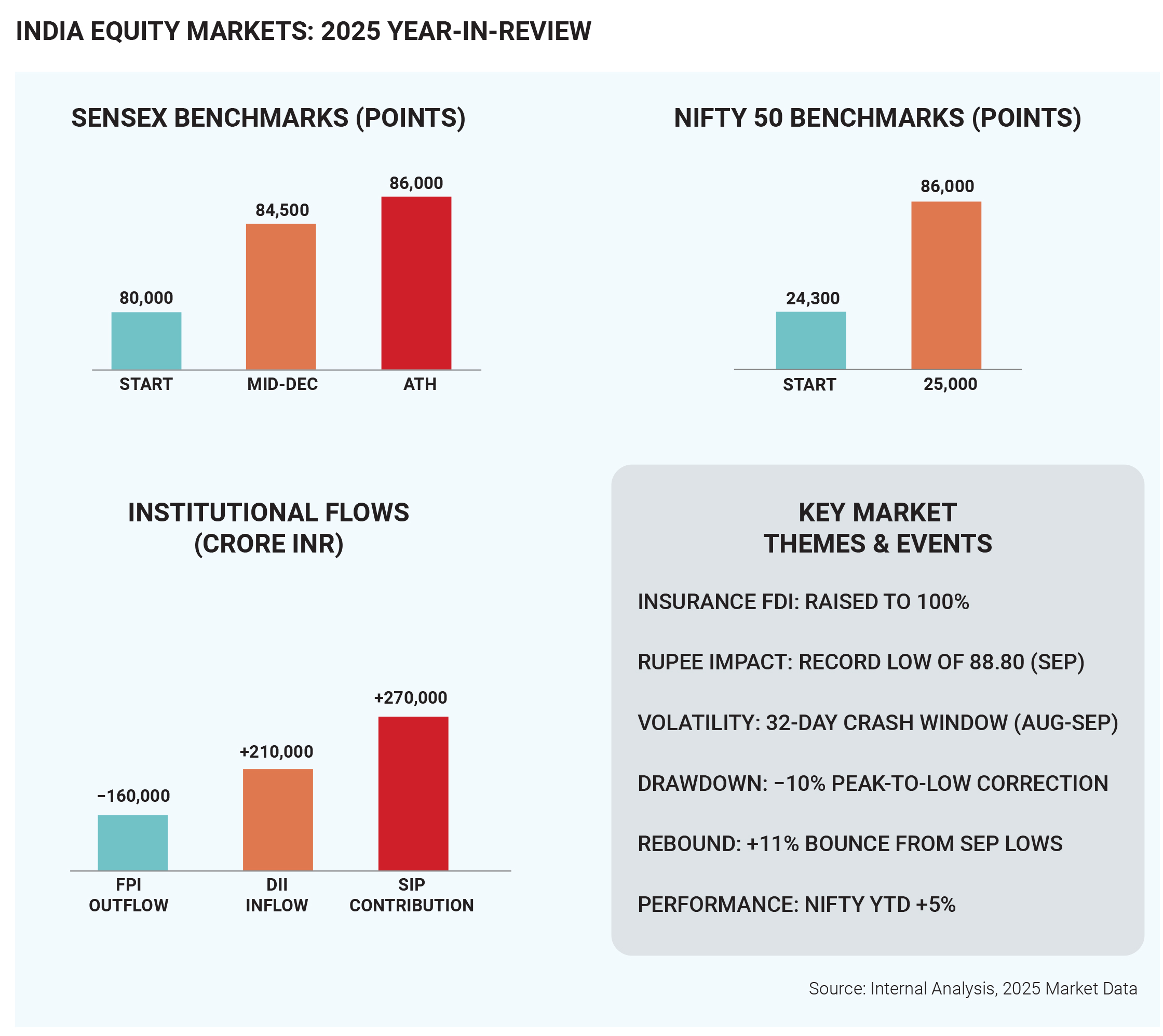
Volatility remained subdued compared with earlier phases of 2025; intraday swings were contained and corrections shallow, underscoring a “buy-on-declines” mindset, especially in large-cap stocks. Beneath the flat headline performance, however, there was clear internal rotation: investor preference shifted decisively toward quality large-caps, defensives and selective cyclicals, while mid- and small-caps, after an extended period of outperformance, largely consolidated. This rotation was shaped by a counterbalancing flow dynamic, with foreign portfolio investors (FPIs) remaining cautious and intermittently booking profits—net outflows for the month were estimated in the ₹19,600–25,000 crore range, driven by global risk fatigue, US policy uncertainty, emerging-market currency stress and sharp rupee depreciation toward 90.8 per dollar—while domestic institutional investors (DIIs) absorbed supply with strong inflows of nearly ₹40,000 crore, supported by steady SIP contributions, insurance and pension allocations.
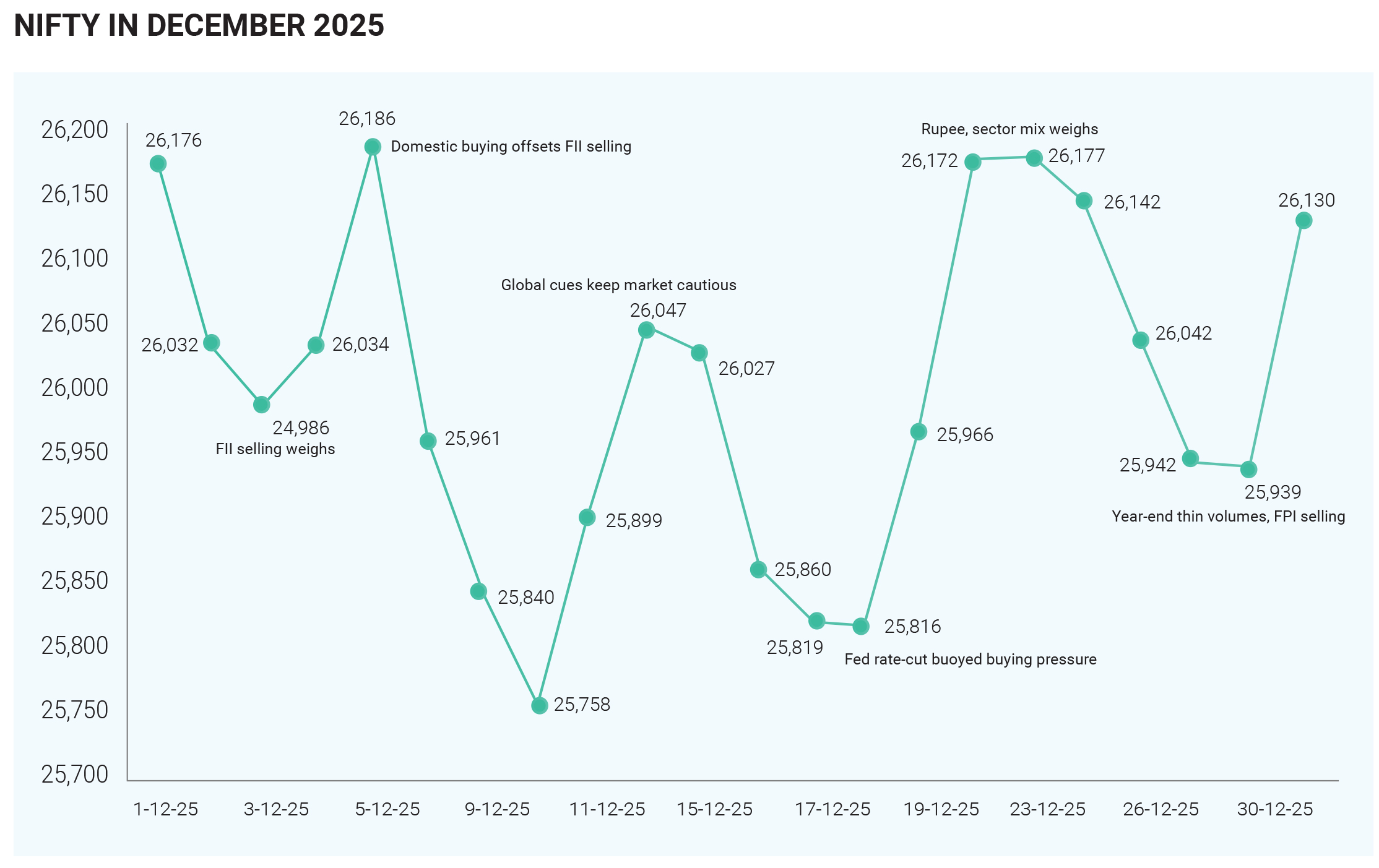
The divergence between foreign selling and domestic buying prevented deeper drawdowns, kept market breadth tilted toward liquid frontline stocks, and reinforced the perception that domestic capital had become the marginal price-setter. Sectoral performance was notably differentiated compared with November’s broad-based rally: IT stocks benefited from sustained global demand for digital and AI-linked services and from rupee weakness, which supported earnings translation and margins; healthcare and pharma held up well as defensive plays with stable demand visibility, particularly in domestic-focused names and hospital chains; energy stocks outperformed on value buying and policy support, with integrated and downstream players aided by lower crude prices and expectations of healthy refining margins; financials delivered mixed but generally supportive performance, with PSU banks and select rate-sensitive lenders gaining on expectations of strong credit growth and an accommodative policy path, while some private banks faced intermittent pressure due to concerns around net interest margin compression and pockets of asset-quality stress; consumer sectors saw profit-taking in FMCG after earlier resilience despite improving volume trends and easing inflation, while discretionary stocks were stock-specific, with autos supported by demand and rate-cut hopes but retail names consolidating after sharp prior rerating; utilities remained among the weaker segments, as concerns around tariffs, demand visibility and operational pressures capped enthusiasm, limiting buying to balance-sheet-strong names; and metals and industrials moved in a choppy but mildly positive fashion toward month-end, helped by import-related policy measures, domestic capex expectations and year-end positioning despite uneven global demand indicators. The macro backdrop during the month remained largely supportive domestically: Q2 FY25 GDP growth around 8% exceeded expectations, inflation stayed benign, and the RBI delivered a dovish policy signal by cutting the repo rate by 25 basis points to 5.25%, announcing ₹1 trillion in open market operations and a USD 5 billion buy/sell swap to inject liquidity, which helped soften bond yields and underpin sentiment. However, these positives were tempered by external pressures, including a firm US dollar, weak emerging-market currencies, geopolitical uncertainty, US trade policy risks, China’s deflationary signals, and falling crude prices, all of which reinforced caution among foreign investors. The rupee’s nearly 2% depreciation over the month weighed on foreign returns but also highlighted India’s relative resilience: instead of triggering disorderly selling, equities absorbed the shock through sideways movement as domestic flows cushioned the impact. By year-end, market positioning clearly favoured quality, earnings visibility and balance-sheet strength over high-beta momentum, with index valuations cooling modestly from peak optimism but remaining supported by earnings delivery and liquidity. Overall, December 2025 closed with Indian equities in a deliberate, balanced stance: headline indices near record highs but without exuberance, foreign investors cautious but not capitulating, domestic institutions firmly in support, and the market entering 2026 consolidated, selective and grounded in fundamentals rather than momentum.
Indian debt markets in December 2025 navigated a
complex mix of supportive domestic policy actions and
constraining external and supply-side pressures,
resulting in a month of modest yield softening rather than
a sustained rally. Government bond yields eased
meaningfully through the middle of the month as the
Reserve Bank of India stepped up liquidity support, but
those gains were partly retraced toward month-end amid
heavy borrowing supply, currency weakness and global
rate headwinds. The benchmark 10-year government
security yield began December near 6.85%, declined
steadily as RBI interventions took effect, touched a low of
around 6.54% on December 24, and then stabilized in the
6.60–6.61% range by the end of the month.
Despite the late-month uptick, yields finished December
lower than they began, translating into positive returns
for duration-sensitive bond funds, although the extent of
gains remained capped. The RBI played a central role in
shaping market dynamics during the month, delivering a
25 basis point repo rate cut to 5.25% and complementing
it with large-scale liquidity measures, including open
market operations (OMOs) totalling roughly ₹2 trillion in
December alone and cumulative purchases exceeding ₹3
trillion for FY26, the highest on record. These bond
purchases, focused largely on the 6–7 year segment
such as the widely traded 6.33% 2035 bond, significantly
eased systemic liquidity conditions and compressed
term premiums, offering relief to a market that had been
grappling with cash shortages stemming from currency
in circulation outflows and RBI forex interventions.
Additional support came from USD 5 billion buy/sell
swaps, which injected durable rupee liquidity of ₹2–3
trillion and helped anchor overnight rates closer to the
repo rate. At the shorter end of the curve, one-year
government bond yields remained relatively stable in the
5.84–5.90% range, while overnight index swap (OIS)
rates between 5.46% and 5.76% early in the month
reflected intermittent liquidity tightness that gradually
eased as RBI measures filtered through the system. Even
with these actions, however, liquidity conditions were not
unambiguously comfortable: surplus liquidity declined to
around ₹3.3 trillion at times, and RBI infusions had to
counter an estimated ₹1.5–2 trillion drain from strong
credit demand and ongoing forex operations.
On the fiscal and supply side, persistent pressures
limited the scope for a deeper rally in yields. The
government’s borrowing program remained heavy, with
record state development loan (SDL) issuances in the
December quarter and a particularly large supply pipeline for
Q4, which weighed on demand-supply dynamics even as
OMOs absorbed some of the pressure. Concerns around
fiscal slippage also lingered, driven by a combination of tax
cuts, moderation in GST collections, and a high central
government debt burden—estimated at over 60% of total
market borrowings—which kept investors cautious about
aggressively extending duration. Banks’ holdings of
government securities fell to around 35.3% year-on-year,
indicating some balance-sheet constraints, while pension
funds showed signs of reallocating toward equities amid
strong stock market performance, reducing a traditionally
stable source of long-term demand.
Currency movements further complicated the picture, as the
rupee depreciated sharply by nearly 2% during December,
slipping to around 90.8 per US dollar amid heightened global
risk aversion, US tariff announcements of up to 50% on
certain trade fronts, and a firm dollar environment. This
depreciation raised concerns about imported inflation and
triggered bouts of foreign portfolio investor outflows from
the debt market, contributing to intermittent yield hardening
despite domestic easing. Inflation data at home remained
benign, supported by falling food prices, favourable base
effects and a decline of about 4.4% in global crude oil prices,
but global inflation persistence and the risk of currency
pass-through prevented markets from pricing in an
aggressive or front-loaded easing cycle.
Global factors continued to exert influence throughout the
month, with US Treasury yields holding above 4%, limiting
the relative attractiveness of Indian debt, while ongoing
tightening bias in parts of Europe, China’s deflationary
signals, and broader geopolitical uncertainties added to
volatility. Strong domestic macro data also played a
nuanced role: Q2 GDP growth of about 8.2% year-on-year led
to upward revisions of FY26 growth expectations toward
7.2%, reinforcing confidence in the economy but
simultaneously tempering expectations of sharp rate cuts
and anchoring longer-term yields.
As a result, while the RBI’s dovish stance and liquidity
operations successfully stabilized the bond market and
delivered moderate gains, especially in the belly of the curve,
external headwinds, fiscal supply pressures and currency
risks ensured that December 2025 remained a month of
measured easing rather than a decisive bond rally,
leaving the market balanced between supportive policy
and persistent structural constraints heading into 2026.
The Indian rupee weakened sharply against the US dollar
in December 2025, extending a year-long depreciation
trend and emerging as Asia’s worst-performing major
currency, though without signs of a balance-of-payments
crisis. The month began with the rupee trading around
₹89.6–89.7 per dollar but quickly slipped under
persistent pressure, breaching ₹90 in the first week,
touching record lows near ₹90.49 by December 11, and
briefly crossing ₹91 in mid-December before stabilising
toward the end of the month in the ₹90.8–90.9 range.
Overall, the rupee declined by about 2% during December
alone and more than 5% on a year-to-date basis,
significantly underperforming several Asian peers
despite a broadly stable global dollar index. This sharp
move reflected a convergence of domestic imbalances
and external shocks rather than a single trigger.
A major driver was sustained foreign portfolio investor
outflows, with FPIs selling over $1.6 billion of Indian
equities and debt during December and cumulative
equity outflows exceeding ₹1.48 lakh crore for the year,
as investors rotated toward safer dollar assets amid
global uncertainty, elevated US yields and concerns over
Indian asset valuations. These flows translated directly
into higher dollar demand as funds were repatriated,
intensifying pressure on both spot and forward currency
markets. Trade-related concerns compounded the
problem, as stalled US–India trade negotiations and
aggressive tariff hikes by the US—reportedly up to 50% on
key Indian exports such as textiles, pharmaceuticals and
electronics—eroded confidence in India’s external
earnings outlook and threatened export competitiveness.
These fears came on top of a widening trade deficit, with
weak global demand dragging exports lower while
imports surged due to higher purchases of gold, crude oil
and capital goods, forcing corporates and refiners to
front-load dollar buying. Currency market dynamics were
further amplified by heavy importer hedging and stress in
the offshore non-deliverable forward (NDF) market,
which pushed up forward premia and magnified each
bout of risk aversion.
Against this backdrop, the Reserve Bank of India adopted
a consciously measured approach, intervening selectively to
smooth volatility rather than defending any specific level.
While the RBI reportedly sold dollars intermittently—drawing
down reserves but keeping them at comfortable levels—it
allowed the rupee to act as a “shock absorber,” consistent
with its growth-supportive stance following a 25-basis-point
rate cut and the IMF’s classification of India’s regime as a
managed, crawl-like arrangement. This policy tolerance of
gradual depreciation helped prevent panic but also meant
that external pressures were reflected more fully in the
exchange rate.
Market reactions to the weaker rupee were contained rather
than disorderly: bond yields firmed slightly as currency risk
and current-account concerns lifted term premia, equities
faced intermittent foreign selling even as domestic investors
provided support, and the real economy confronted
near-term headwinds from imported inflation and costlier
foreign borrowing. At the same time, some analysts noted
that a weaker rupee could partially offset tariff damage by
improving export price competitiveness over time. By late
December, the breach of the psychologically important ₹90
level was widely interpreted not as a crisis signal but as a
policy-tolerated reset driven by trade shocks, capital
outflows and global risk aversion, leaving the rupee
stabilised but vulnerable heading into 2026 until clarity
emerges on tariffs, portfolio flows and global monetary
conditions
Crude oil prices weakened further in December 2025,
extending a year of pronounced declines as oversupply
concerns and soft global demand continued to dominate
market sentiment. West Texas Intermediate (WTI) crude
opened the month near USD 59.5 per barrel and drifted
steadily lower, falling into the high-USD 50s by
mid-December and ending the month in the USD
56.5–57.9 range, before slipping to around USD 57.3 in
early January 2026. On a monthly basis, WTI lost roughly
2–3%, capping a full-year decline of more than 20% from
highs above USD 80 seen earlier in 2025. Brent crude
followed a similar trajectory, easing from early-December
averages near USD 61–62 per barrel to around USD 60.7
by end-month, down just over 3% in December and
marking its fifth consecutive monthly fall. Although
intra-month volatility remained elevated, with sharp
swings driven by inventory data and geopolitical
headlines, the broader trend was decisively downward asmarkets increasingly priced in a sizeable supply surplus
for 2026.
The primary driver of December’s weakness was
persistent oversupply. OPEC+ producers, including
Russia, continued to pump at elevated levels despite
nominal quotas, while non-OPEC supply—particularly
from the US—remained resilient. Even when US crude
inventories showed occasional draws, such as a roughly
4.8 million barrel decline reported mid-month, product
inventories told a different story: gasoline and diesel
stocks continued to build, signalling weak refining
margins and subdued end-user demand. This reinforced
the view that supply was outpacing consumption, limiting
the market’s ability to sustain any meaningful rebound.
On the demand side, global consumption growth
disappointed. Manufacturing activity in major
economies, including China and parts of Asia, remained
sluggish, freight volumes softened, and industrial energy
usage stayed muted, outweighing seasonal or festive
demand. Forward-looking forecasts increasingly pointed
to a structural glut in 2026, as non-OPEC supply growth
was expected to exceed incremental demand even under
optimistic growth assumptions.
Geopolitical risks, which had supported prices earlier in
the year, proved insufficient to offset these
fundamentals. While ongoing Russia–Ukraine tensions,
sporadic attacks on energy infrastructure, and
uncertainty around sanctions on producers like
Venezuela injected brief risk premiums into prices, these
moves were short-lived. Markets increasingly judged that
geopolitical developments were unlikely to result in
sustained, large-scale supply disruptions, especially with
diplomatic channels open and spare capacity available
elsewhere. At the same time, macroeconomic conditions
added another layer of caution. A firm US dollar, with the
dollar index holding above 108, made oil more expensive
for non-US consumers, while lingering hawkishness from
the US Federal Reserve and concerns about a global
growth slowdown capped investor appetite for
commodities
For India, the December decline in crude prices was
broadly constructive. Brent crude around USD 60–61 per
barrel helped contain the oil import bill, supported the
current account, and eased inflationary pressures
despite higher import volumes. Lower energy costs also
reduced fiscal stress linked to fuel subsidies and input
costs for downstream industries. However, the
underlying reason for lower prices—weak global
demand—also carried negative implications, particularly
for India’s export outlook and global trade momentum.
Overall, December 2025 reinforced the view that oil
markets were transitioning into a lower-price regime, with
prices likely to remain range-bound in the USD 55–75 per
barrel zone into 2026 unless disrupted by a major supply
shock or an unexpectedly strong rebound in global
growth.
Gold and silver prices in India remained elevated through
most of December 2025, supported by a mix of global
safe-haven demand, currency effects and central bank
buying, before correcting sharply in the final days of the
month as profit-taking and year-end rebalancing set in.
Domestic 24K gold traded comfortably above the
₹14,000 per gram mark for much of the last week of
December, touching highs near ₹14,242 per gram on
December 27–29, but momentum faded quickly
thereafter. Prices fell to around ₹13,620 on December 30
and settled near ₹13,588 by December 31, marking a
steep decline of about 4.5% in the final stretch of the
month. Correspondingly, 22K gold ended December near
₹12,455 per gram and 18K around ₹10,191. Silver
followed a similar pattern, rising earlier in the month on
safe-haven inflows before softening toward the end as
risk appetite improved in equities and speculative
positions were unwound
The late-month correction was primarily driven by
aggressive profit-booking after a strong rally. Gold had
posted substantial gains earlier in the year, leaving prices
technically overbought, with momentum indicators such
as the relative strength index moving above 70. This
prompted traders and investors to lock in profits,
especially as the calendar year drew to a close. In India,
physical demand also tapered after the Diwali and
wedding-season peak, reducing support from jewellery
buying and encouraging dealers and investors to offload
holdings as part of tax planning and portfolio
rebalancing. Similar dynamics were visible globally,
where COMEX data showed speculators trimming long
positions after year-to-date gains of more than 25%,
reinforcing the downward pressure into month-end.
Despite the correction, gold’s broader tone in December
remained resilient, underpinned by geopolitical and
macroeconomic uncertainties. Early in the month,
heightened tensions in the Middle East, continued risks
around the Russia–Ukraine conflict, and intermittent
friction involving Venezuela and US sanctions injected a
risk premium into bullion prices, briefly pushing global
spot gold above USD 4,400 per ounce. These
developments supported safe-haven flows into
gold-backed ETFs and sustained central bank interest.
Global spot prices, while volatile, still ended December up
around 3% on a monthly basis, easing from late-month
highs to about USD 4,330 per ounce by early January
2026.
Currency movements played a critical role in shaping
domestic prices. The sharp depreciation of the Indian
rupee toward ₹90.8 per US dollar amplified local gold
prices through most of December, effectively adding an
import premium even when global prices softened. This
currency effect helped insulate Indian gold prices from
sharper declines earlier in the month. However, strength
in the US dollar, with the dollar index holding above 108,
capped international gains and eventually contributed to
the late-month pullback in ounce-denominated prices.
Falling crude oil prices helped ease import costs but
were insufficient to offset the combined impact of
profit-taking and stronger dollar dynamics.
Central bank buying remained a structural support.
Ongoing purchases by the RBI and other major central
banks, including China, reinforced gold’s role as a
long-term store of value amid de-dollarization trends and
geopolitical uncertainty, even as short-term momentum
faded. Overall, December 2025 for gold and silver was
characterized by a classic pattern of early resilience
followed by a sharp technical correction, leaving bullion
prices lower at the margin but still elevated in a broader
historical and strategic context heading into 2026.

In December 2025, India’s mutual fund industry navigated
a mixed but resilient environment, shaped by equity
market volatility, structural shifts in investor behaviour
and a few high-profile industry developments. A key
highlight was the ICICI Prudential AMC IPO, which
opened between December 12 and 16 and raised about
₹10,602 crore, drawing strong investor interest and
underscoring confidence in the long-term growth of the
asset management business. The listing brought
renewed visibility to the sector at a time when industry
assets under management (AUM) were hovering around
₹80–82 lakh crore, supported more by mark-to-market
gains than by aggressive net inflows. Despite intermittent
FII outflows and market consolidation, retail participation
remained stable, with SIP inflows staying robust at over
₹29,000 crore for the month, pushing annual SIP
collections beyond ₹3 trillion for the first time and
reinforcing the stickiness of domestic flows
At the same time, fund houses adjusted portfolios
cautiously. Cash holdings, which had been pared by
nearly ₹7,000 crore earlier during market rallies, remained
elevated on a year-to-date basis at around ₹2.01 lakh
crore, reflecting a preference for liquidity and selective
deployment. New fund offer (NFO) collections continued
to disappoint, with year-to-date mobilisation falling to
about ₹63,600 crore by November, weighed down by
tighter SEBI regulations, fewer thematic launches and
subdued investor appetite amid volatile equity
conditions. This led to a slowdown in new investor
additions, which stood at roughly 5.8 million, and shifted
fund-house focus away from NFOs toward established
schemes.
Flow trends across segments highlighted this
recalibration. Equity mutual funds saw moderated net
inflows, largely SIP-driven, with flexi-cap and
mid-/small-cap categories attracting interest even as
lump-sum investments stayed cautious. Debt schemes
experienced net outflows of around ₹8,400 crore,
reflecting liquidity needs and cautious corporate
treasuries. In contrast, hybrid funds recorded healthy
inflows near ₹12,000 crore, driven by demand for
arbitrage and multi-asset strategies, while passive funds
continued to gain share, with AUM exceeding ₹14 lakh
crore, supported by steady inflows into gold and silver
ETFs. Overall, December reflected a mutual fund industry
that remained structurally strong, supported by
disciplined retail participation, even as near-term flows
adjusted to market volatility and regulatory changes.
